Blog Post 6: Contexts of Procurement and Supply

Understand the added value that can be achieved through procurement and supply chain management

  • Explain the categories of spend that an organisation may purchase
  • Analyse the different sources of added value in procurement and supply
  • Compare the concepts of procurement and supply chain management
  • Differentiate the stakeholders that a procurement or supply chain function may have

Understand the stages of sourcing processes in creating added value outcomes that can be achieved

  • Explain the main aspects of sourcing processes
  • Analyse the main stages of a sourcing process
  • Explain how electronic systems can be used at different stages of the sourcing process
  • Analyse the relationship between achieving compliance with processes and the achievement of outcomes

Understand the main aspects of organisational infrastructure that shape the scope of a procurement function

  • Explain the main aspects of corporate governance of a procurement or supply chain function
  • Analyse the impact of organisational policies and procedures on procurement
  • Compare the different structures of a procurement or supply chain function
  • Explain the common IT systems that can be used by a procurement or supply chain function

Understand the need for compliance with requirements when undertaking procurement activities

  • Identify different economic and industrial sector
  • Analyse the impact of the public sector on procurement or supply chain roles
  • Analyse the impact of the private sector on procurement or supply chain roles

Blog Post 5: Analytical observations of supply chain literature and commercial prospects

The transaction of selling and buying goods is a concept that is drawn from a history that is hundreds of years old. It’s a simple process in many ways which can often be disguised due to the way it’s presented, specifically on a larger, global scale where trading relations creates countless jobs and activity. Expanding economic interaction across countries is often referred to as globalisation, a term which McLaren ,2013, pg. 8 notes as ‘a way to buy and sell goods/services across national borders; for a firm in one country to set up production facilities in another; for an investor to invest in securities originating in another country; and for a worker in one country to travel and seek employment in another’. The complexities surface when political factors such as those formed from immigration policies and tariffs are applied which make the environment more difficult to trade in. This is especially relevant for those countries which are developing, where the GDP and national economy isn’t as strong as those who are willing to trade via their own preferred strategy of comparative advantage[1]. Producing and selling goods in the world economy is therefore as much a political process as it is a financial imperative to survive and grow. Developing suitable strategies which understand competitive relations and power dynamics in the market whilst simultaneously recognising the need to turn over a profit is therefore vital. The marriage of political and economic factors is as much a base of knowledge to be aware of as it is an opportunity to manage the different principles to positive effect.

Managing the different considerations of trading activity in supply chains has been defined and outlined in many ways. Professor of the MIT Sloan School of Management Jay Wright Forrester was a key facilitator in acknowledging management as a holistic discipline, and associated such practices with the term ‘Supply Chain Management’. As early as 1958 Forrester noted, “Management is on the verge of a breakthrough in understanding how industrial company success depends on the interactions between the flows of information, materials, money, manpower and capital equipment… The way these five flow systems interlock to amplify one another and to cause change and fluctuation with form the basis for anticipating the effects of decisions, policies, organisational forms, and investment choices”. Categorical as they may seem, Forrester was able to outline the relation between such variables and demonstrate that interactions have their own momentum and lead to outcomes which vary and fluctuate in their own ways. Mentzer et al, 2001, pg. 18 details that the purposes of such outcomes are to, ‘improve the long-term performance of the individual companies and the supply chain as a whole’. Performance in this instance is not just subject to a financial value but also an opportunity to be more involved in the marketplace. Whereby the different processes and activities that produce value for the consumer are more closely scrutinised/analysed (Christopher, 1992). Becoming more involved, stretching capabilities and evolving is as much a philosophy (Cooper and Ellram, 1993) as it is a working practice (Tyndall et al, 1998). Dedication to management can therefore been seen as a mind-set, which is there to be honed by the workforce and for the benefit of the market place.

Performance is also increasingly being linked to sustainable practices, a topic which has been much discussed but left open for further exploration, discussion and action. Often considered a ‘license to do business in the twenty-first century (Carter et al, 2011 p.14)’ sustainability is all about responsibility and information in supply chains being accessible to consumers so that they can decide whether they agree to support the business in practice or decline its marketing appeals. Carter and Rogers use the word ‘transparent’ which is a good way of thinking about it, defining the term as, ‘the strategic, transparent integration and achievement of an organisations, social, environmental, and economic goals in the systemic coordination of key interorganisational business processes for improving the long-term economic performance of the individual company and its supply chains’ (Carter and Rogers, 2008, p. 368). While initially not seen as a measure of financial success (Walley, 1994) it has moved beyond common practices of supply chains and served as an analytical curiosity. Whereby life-cycles of products, the costs of wastage created and the generation of by-products (Linton et al, 2007) can all be viewed as projects to serve environmental concerns. Thus, supporting a culture whereby consumers are informed and respected for their concerns instead of being viewed as passive, routined purchasers.

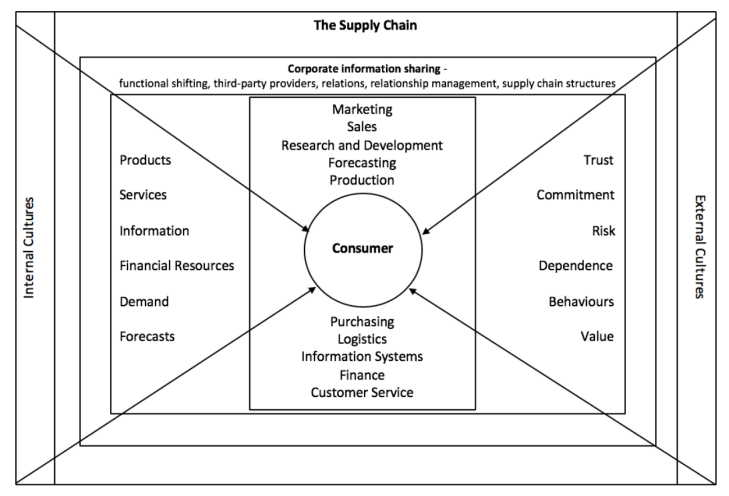
What it interesting about this is how Forrester’s earlier claims of ‘transactions of information (1958)’ have developed from being something internally considered to something which is actively part of consumer behaviour. Managing is therefore not just subject to a series of processes and internal values but also to the image of the industry from the outside. The next steps are therefore to consider each process as a suitable concept for consumers to understand and respect, a management principle which respects a knowledgeable consumer as well as financial value. This pressure is different depending on the culture products are being sold into but the denial of recognising these factors are generally to the detriment of organisations whose management staff are ill-informed to the external rhetoric and cultures. Growing as a community and not just as a business is therefore pivotal for the momentum of Forrester’s earlier claims to truly sink in. Let’s now consider the full scale of this, by adding the model of supply chain management (Mentzer, 2001, p 19) with an outline of ‘intelligent consumerism’.

Screen Shot 2018-09-10 at 18.40.32.png

Consumer focused framework – basic conceptualisation for considering the consumer as someone who is informed, prioritised and considerate to the processes related to product life-cycles. Partially inspired by/developed from Mentzer et al, 2001, pg. 19, Journal of Business Logistics Vol 22, No 2 

The consumer focused framework prioritises the consumer themselves, putting them at the centre of the supply chain network. In this instance, the consumer can either be a certain individual or a select group of people; they can be the buyer themselves but more appropriately they are the user whose request for the product is drawn from a set of needs and/or wants. To think of it another way, think of the different elements of the supply chain as the foundations of a property, the internal and external cultures as bricks and the consumer as the cement which holds the different elements together. What is important about this theory is that by putting the consumer at the centre there is a clear determination as to where the focus lies, threading the different elements and processes together to sustain a certain synergy.

What is useful about thinking of the supply chain network as consumer led is that it prioritises sharing knowledge to its consumers in order to be more attractive to them for further purchases. It demands each task to be re-examined, challenged and shared with its audience in order to thrive and create sustainable measures within its business practices. Logically, this is rather a naive and perhaps optimistic theory which is poorly executed as the core principles of the market is always going to be financial (both profitable and/or maintainable in its budget). But the challenges of putting only financial variables at the centre of the framework is that it creates a mentality in which consumers are considered numbers rather than minds who fluctuate in terms of their own thought. Sustaining their working practices to fulfil the demands set by consumers is therefore a much more promising way of determining strategies which strengthen opportunities for growth as it respects the fluctuating psychology and nature of the market.

This idea is not to say that information sharing is whole in terms of it’s transparency. If anything, organisations will determine the information they share with tight regulation and consistent analysis. Progressive practices which help to develop this is not easy, especially when considerations to middle-tier and off-contract suppliers are not always complaint and visible to the practices of the end user. The more successful an organisation is, can therefore be determined by how many changes are made and how accessible they are shown to audiences.

[1]Easiest way to think about comparative advantage is if you consider the power one country may have due to the stronger capabilities and products they have over other countries. Often it’s not just related to the product a country grows/manufactures by themselves but is a product of a series of factors such as physical capital, legal power, labour market, education/strategy, economic climate etc.

Blog Post 4: Continuation/A brief note

Screen Shot 2018-08-21 at 21.26.48

This is more of a note to outline some of the key concepts which I’ve tried to establish so far. Like the diagram above, the idea that supply chains fits a specific pattern and stays within it’s own mould is not what is interesting about them. The process is more slippery, takes a lot of work to manage and requires ambition to modify the chain of events to ensure progressive methods are implemented. Only then can any intelligent visualisation of the supply chain emerge which is stronger from what has come before. I’m going to try to move forward now from the introductory nature of the previous blog posts starting with an analytical piece observing the academic and commercial landscape of supply chain literature and develop from there with a focus on operational and financial procedures of procurement and supply.

Blog Post 3: Procuring (purchasing), Holding (storing), Supplying (selling) and Exporting (selling).

In the second blog post I discussed some of the core frameworks of supply chains, in which time, labour, design, finance and communications all function simultaneously in order to create sustainable operations. In this next section I’m going to establish how these frameworks manifest in reality, specifically defining some of the title roles given to activities related to supply chains. While the information might be heavy on exposition it is also critical to identify as it helps to indicate how responsibilities are motivated, distributed and actioned over time.

  1. Procuring
  2. Storage
  3. Supplying/Exporting

1.Procurement

Procurement can often be identified as a process of ‘purchasing goods or services’ and for those unfamiliar, categorising the role in such a way is an efficient yet limiting definition of the term. Procurement is a technical discipline which has its own comprehensive activities created in order to support supply chain life-cycles. The chartered institute of procurement (CIPS) (1) identifies activities associated with the term including the following:

  • Sourcing:finding relevant suppliers (products and services), identifying requirements which are needed, establishing them as contractors, planning and analysing trends which will support operational practices. These activities can be thought of as ‘pre-contract’ activities.
  • Management:once sources have been identified management practices are put in place that support contracts with suppliers. This can be practices such as: corporate governance, supplier relationship management, risk management and regulatory compliance.  Such practices can be thought of as ‘post-contract’ actions.

Both sourcing and management practices are there to support the aims and objectives of the organisation. Projects related to designing effective supply chains, collaborating and bench-marking marketing agencies are used as such aspects of such support. In the long term, these activities are there to ultimately support financial viability, whereby optimising costs and documenting savings are there to support sustainable operations.

Sources: https://www.theguardian.com/careers/careers-blog/why-you-should-consider-a-career-in-procurement

https://www.cips.org/Documents/CIPSAWhitePapers/2006/Definition_of_Procurement.pdf

  1. Storage

Creating an infrastructure which securely stores goods is an integral part of supply chains. Warehouse operations that take into consideration the identity of goods (e.g. temperature controlled) and their requirements are of equal importance to the way they are transported and documented. Considerations of the movement of goods, how to organise a process of efficient practices and sustain an operation with minimal disruption is therefore key in recognising that holding goods is not just a routine practice but an active mechanism in the supply chain which requires careful management and decision making.

Warehousing has thus far been described as something which is fast-paced and rather slippery in terms of the consistent movement of goods. In addition to this, warehousing helps to monitor inventory items and can help to ensure suppliers and buyers have access to transportation services  – in which orders are fulfilled and delivered at a specific time. Any successful supply chain process requires a meticulous understanding of where the goods and services are at a given time – for storage systems, the warehouse helps to optimise this requirement. Intelligent technology, strong leadership skills and logistical knowledge has to make sense of the logic of the movement of goods in order to be of benefit to the market. It is only then, that storage practices can be effective in supporting the holistic nature of supply chain processes.

Sources: https://www.shopify.co.uk/encyclopedia/warehousing

https://intralogistics.tips/effective-storage-strategies-the-basis-for-successful-warehouse-management/

  1. Supplying/Exporting

Supplying and exporting goods from seller to buyer requires the right documentation and a suitable freight forwarder. Charges associated with the export of goods is dependent on where the goods are being transferred too. For international trading agreements, the following charges are to be considered: freight costs, terminal handling, document fees, security surcharges, infrastructure charges, administration fees, packaging, delivery charge , customs clearance charges, valuation statement (if goods are over a certain amount) etc.

In addition to this factors such as delivery methods, duties/tax payments and who is responsible for insuring/paying the insurance of the goods are to be taken into consideration. Fulfilling the criteria of documentation and understanding the costs associated with supplying goods is clearly a job in and of itself – which requires an understanding between both supplier and buyer as to who is responsible for the goods at different times of the exporting process (specifically helpful when issues/challenges occur). For this, a series of regulations and guidelines will be put in place that are helpful when trying to maintain export practices on a consistent basis.

Characteristics of the products being supplied also carry with them their own expectations when deciding on suitable exporting practices. This is relevant when considering Dangerous Cargo (DG) and heavy cargo which may result in additional charges being applied. On top of this, certifications of goods such as fumigation and phytosanitary may be required alongside packing lists of the goods themselves.

Listing the exporting costs and practices may seem over-whelming but if anything they re-affirm the notion that the supply of goods is a holistic discipline which requires careful planning, management and analysis practices for effective results. The scale and detail that is required can often get lost when recognising that in practice the routines created to deal with these variables are very much active in the supply chain process. This takes us to our next section which looks at the roles of supply chain co-ordinators and inventory managers.

Source: https://www.gov.uk/guidance/international-trade-paperwork-the-basics#export-documentation


Blog post 2: Considering some basic principles of the supply chain network

“Success would come through a process, an accumulation of tactical actions over time, rather than a single tactical event”. 

The quote above is taken from the publication ‘Understanding Land Warfare’ (Tuck, 2014, p. 85). Success from this angle, is derived from the concept of a series of actions which each work together in order to create a certain outcome. The satisfaction of success is therefore not singular but multifaceted – whereby each action, process and movement is designed to be successful in its own right. Multifaceted success is therefore as much a pivotal working mechanism as it is a fulfilment of demands. Or to put it another way, success is as much a process as it is an end result which is sustainable and has the potential to grow if managed correctly.

Whilst this concept of success is derived from ideas surrounding land warfare it is possible to understand the multifaceted angle as something more broader which can relate to social and economic agendas in industries not just related to those of defence. As to be successful is for an organisation to make intelligent decisions, to be curious, make smart investments and build a team who are supported to be strong in their work life. Their strategy for commercial profit is as much about understanding that the ethics and toil which they put into their organisation is of equal importance as the returns they make. Without an understanding of every angle, the ambition to learn and grow has the potential to falter and success to be limited rather than sustainable.

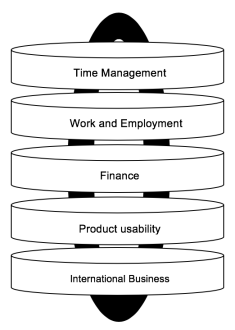
For the purpose of this blog post, supply chain success is intrinsically linked to this multifaceted angle. As without conceptualising the breadth of supply and demand, there is a risk of having a chain of events which aren’t sustainable in the long-term, creating undesired effects within the market. The following part of this post will explore some of the key aspects of sustainable success. Specifically, the frameworks will be broad in their nature as at this time I just want to outline them so that they can be analysed and applied as the blog progresses.

  • Time Management
  • Work and Employment
  • Finance
  • Product usability
  • International Business and Development

Time Management 

I’ve decided to start with time management as it can be a key framework in understanding how supply chains operate in real time. As an example, when dealing with commodities, the life-cycle of a product is determined by a series of factors such as: conception, resourcing, analysis, adaption and integration into the market. All of the variables that are taken into consideration are there to be both profitable and sustainable. Without an understanding of how the different segments work together, there cannot be an understanding that a supply chain is a sum of all its parts (a holistic discipline/process). Meaning that every aspect has to be attended too and given an appropriate amount of time to plan and process  – in effect, supporting the requirements needed for supply chain sustainability.

Time management is not only a way to ensure that the effort given is recorded to maintain operations, it also encourages efficient practices which support development opportunities to take place. Managing each activity is a full-time job in and of itself and needed in order to ensure the other variables of the supply chain are well maintained. However, without the capacity to recognise patterns of repetition it becomes difficult to apply changes which encourage strategies of improvement. The question then becomes, why are practices of supply chain operations needing to be progressive if routine and regulations work in terms of being commercially profitable? The answer is two-fold. For one the demands of supply chain activity are based on the demands of the market. If the market is busy, steady or disrupted the operations have to respond competently. Hence, the more thought and discussions that are created, the more opportunity there is in securing suitable answers/resolutions which are helpful. Second, maintaining control of supply chain activity is required in order to have confidence in the actions which are unfolding, but no-one can predict how things will change – meaning that the nature of the market is fluid and serendipitous. Being open to this reality and letting go of some of the control of the philosophy of the tight management practices is therefore pivotal as it helps to spur on attitudes which are considerate and progressive instead of monotonous and complacent in the strategy which is implemented.

When considering time management in supply chain activity, it is important to recognise that ultimately it’s a framework which supports analytical and critical thinking. The success and failures can be lessons as to how best to move forward in order to try and develop supply chain activity even further. Analysis through documenting, fore-casting and communicating findings to one another is an example of how time management frameworks can potentially work in reality. In effect, helping to create changes and decisions which support the organisations ambitions.

Work and Employment

While time management is useful in terms of conceptualising tasks both as individual processes and as a whole, it is of equal importance to consider employees who facilitate such activity. Capabilities such as integrating, analysing and developing supply chain processes cannot be taken for granted; as to not take a workforce seriously is to hinder sustainable and commercial viability.

Within any working environment you’re only ever as good as the team you are surrounded by, and this is ever so critical in supply chains where the holistic nature requires strong communication skills. Relations between suppliers and buyers, co-ordinators and purchasers, service staff and customers all rely on consistent, reliable communication networks. Therefore, taking any member of staff for granted and not listening to the voices from different departments is only going to hinder any possible progress both for the individual themselves, the team and the organisation. Ideally, this should encourage training opportunities for workers to develop their skills in support of the industry they are employed in. However, how this manifests is more tricky to measure as skill development is determined by a series of factors such as personal ambition, funding opportunities, encouragement by management staff, length of employment within the organisation, etc.

Categorising workers and ensuring that they are equally trained is also challenged by the fact that supply chains are not strictly operating under one roof. Whilst buyers may go through a rigorous vetting process in order to ensure the suppliers they set contracts for are following their guidelines, they may find their control to be inadequate. This idea is based on the reality that for suppliers they may choose to use additional workers outside of their company to complete certain tasks (SME’s, home-based workers etc). The potential for workers to ‘get lost’ in the supply chain is a reality when considering the suppliers use of additional/contractors workers. Further attention is therefore required, as without regulatory practices there is a risk of maintaining activities which are unethical and unsuccessful in promoting workers rights. Whilst this is a challenge related to suppliers, it’s also important to consider the internal relations which happen within the company who are buying the goods.

Hierarchical structures might work well in terms of distributing responsibilities but how the leaders at the top communicate to the middle and lower-tier is important to recognise. This is because everybody is essentially working for the same goal: to sustain, develop and profit from the organisation both professionally and financially. Recognising any barriers which hinder successful access/communication across the supply chain network therefore requires further challenging. As if the outcome for workers is financial, why should there be political factors which discourage conversation and access to other employees (specially access to higher level/management staff)? This is something to consider as the blog develops and analyses the relation between workers and supply chain operations.

When considering work and employment the key focus is communication, personal development and access to workers within the supply chain. Each will be considered in later posts, for now the outline of financial factors will be established.

Costs and profits

Imagining the realities of integrating time management frameworks and employment capabilities comes more naturally to me than the financial components embedded within supply chain practices. This is because much of my research and employment has been in relation to operational procedures, whereby finance takes on a role which acts more as an outline rather than something to be analysed vigorously. However, in order to develop my knowledge and try to reach a competent level of exposure to financial elements I’m going to attempt to explore the following throughout this project:

  • Product design and commercialisation
  • Costs, profits and profit margins
  • Financial data collection and analysis
  • Risks, successes, failures and sustainability
  • Financial cycles and the relation to the supply chain life-cycle

The following is a brief extract and introduction which sets out to explore the relation between supply chains and finance. The hope is that this will act as a foundational understanding for which the subject headings outlined above can be developed from.

“Financial accounting involves the recording, analysis and communication of financial transactions of an organisation to users. In essence, it is about assimilating an organisations financial transactions into financial statements. Financial management on the other hand deals with helping decision makers in making financial decisions about how funds should be raised by a business and then how they should be invested so that the investment increases the wealth of the owners.”- Ansari Irfan, Accounting and finance in defence logistics, Defence Logistics, 267/268

Financial transactions in their simplest form can be identified as expenditures/costs which are made in order to fulfil a certain operation. The costs are typically used through a budgeting plan which is then processed for the purchase of goods or services to take place.

Categorising inventory items into expenditures can be useful when trying to establish cost-effective practices as strategies of inventory management can make suitable decisions whether to keep the items or discard them. This is done by aligning the amount the items are being utilised with the costs it takes to purchase and provide them. Irfan identifies two types of products: current and capital. Current products are consumed within a finite amount of time in order to fulfil a need for example, food, fuel and wages. Capital, on the other hand, are those whose usability extends beyond a certain activity and can be longer lasting such as vehicles and construction goods.

Processing the costs that are related to inventory items usually falls into two different accounting practices – cash based  or accrual based accounting. For the former, cash is transferred from the seller to the buyer at one particular point in time. This is a useful technique as it makes it easy to identify specific purchases on financial statements but it also lags behind accrual based accounting as factors such as liabilities aren’t taken into account. Under the accrual scheme, the purchase price of an asset is spread over the time a product provides the benefits that it has promised to the customer/buyer. The pressure to rid any inventory which is idle is therefore more apparent under the accrual accounting method – as otherwise the budget will be weakened by products whose usability and costs aren’t aligned enough to support its purpose as part of the budget.

An effective budget takes into consideration the objectives which it seeks to achieve, plans/organises the way it will meet them and successfully co-ordinates and communicates in a way which understands the disciplines of the organisation. Taking a holistic approach to financial transactions and analysis is therefore suitably fitting to the theme of supply chains – as they both prove to be multifaceted in their agendas and activity. The time it takes to make successful transactions both financial and operational takes this holistic nature into consideration when splitting costs into direct and in-direct costs. Direct costs are associated with the value of the inventory item itself, whereas in-direct costs look at the additional costs that are associated with inventory items such as the storage space the item takes up, the time and labour it takes to look after the item. Statistical analysis which takes into consideration time series, probabilities, what-if scenarios, linear regression and probabilities can all help when trying to distinguish changes in direct and in-direct costs for budgetary planning. This isn’t a definitive way to plan as nothing is ever completely certain but it at least gives an indication as to how to move and adapt inventory items for the purpose of cost effective practices and sustainable supply chain management.

For the purpose of defence logistics, considerations of industrial policies, international alliances and government actions make the budgeting process more of an estimate rather than a significant sum which can be deemed 100% accurate. However, as a financial plan, you can’t dismiss the fact that the budgeting set in place does help to support strategic objectives over a period of time which routinely embed financial elements into their logical thinking pattern.

Usability in the age of the globalised market

The previous sections have outlined some of the key components of supply chain procedures, specifically operational and financial considerations. Whilst it might seem obvious, it is important to bring attention to the eventual user of the product which is been manufactured and sold to them. As the strategies developed to support time management frameworks, employment opportunities and financial sustainability will forever be redundant if the product itself does not have the correct aesthetics and functions.

The manufacture of products increasingly take on diverse and complex procedures, whereby it is common practice for organisations to outsource jobs in order to benefit, financially, from cheap labour. This is both an economic and political move, in which the labour involved in crafting a product has its own geographical terrain. Each stage of the process from conception, production and distribution adds value to the product itself and so the pressure of creating effective products in this exhaustive environment is a consistent priority.

For the purpose of this project, I’m looking at exploring these manufacturing processes for products related to supplies to the frontline – specifically medical and general goods. How these products ensure that the labour involved creates a product which can be effectively used whilst ensuring value added practices are managed and maintained is an investigation that will be pursued. I also want to take into consideration the characteristics of the products themselves, simple bites of information which gives an indication as to how products are designed to work.   I feel that a mix between the complexity of procedures and the simplicity of the end result,  will help to give a certain clarity to the cycle of the supply chain of the designed goods in question.

Global value chains is an area which I studied as part of a developmental framework at university. The lines between developmental thought and defence operations forms the next part of this section – that is the relation between humanitarian endeavours and practices of NGOs with the organisations of defence and armed conflict. In the publication ‘Defence Logistics’, Peter Antill discusses how the capabilities of military are deployed to ensure relief agencies can work in an environment which is enveloped by devastation that is caused either by natural factors or those that are man-made. Antill further examines how the aims and strategies differ between those formed from humanitarians experiences and those from defence – suggesting that the relation is a juxtaposition that is both complementary and divided in its ambitions and actions. Antills work acts as a strong introduction to the subject and I’m looking to explore how these relations manifest further – something I hope to find through secondary research.

Resilience, Management and Business

Stringing the above subjects wouldn’t be complete without considering how defence logistics manages the information used to create and maintain a successful operation. This brings to light questions such as:

  • How is knowledge collected and recognised within the logistics value chain?
  • What developments have been made in terms of the ICT platforms which are used?
  • How can business trends and a communal focus spur activity into directions which might broaden horizons for logistical operations or limit them?

Ultimately, how to decipher opportunity, prosperity and intelligent thinking is needed for sustainable practices. As mentioned earlier, these sections will be identified and explored further as the blog progresses, but before then I’m going to establish some of the services which supply chains practice which make them important in the trading market including procuring, holding and exporting goods.                                 Screen Shot 2018-08-14 at 21.30.34
Blog Post 1: Intro

The aim of this blog is to focus on the design and function of medical and general goods, supply chain operations and business trends in the defence industry. I have decided to focus on these areas as they are connected to my professional and academic life. Both have enabled me to explore an interest in the defence market and have opened me up to researching and experiencing how the supply chain operates. In order to capture the concepts I have learnt, and continue to learn, I have decided that a blog would provide the freedom to discuss these topics more informally – acting as both an archive and a trail of thought which support my understanding of the defence industry. Adding to this intention, I hope the blog will be beneficial in the long-run, helping to organise my thoughts more clearly whilst attempting to build my career to a professional standard.

Why design and defence? I have both an Art History Degree (BA Hons) and a Masters in International Development: Globalisation, Trade and industry (MSc). Whilst a student in Manchester UK, I wrote extensively about creative practice and later on grew to appreciate the experience between user and product itself , or rather, the connection formed through aesthetics and usability. After graduating with an Art History degree I worked in commercial firms and decided to escalate my knowledge to something more grounded in  trading relations, hence the masters course choice. I focused specifically on supply chains, defence logistics and work and employment in the global economy which culminated by writing a dissertation on the subject of the logistics value chain in Mombasa, Kenya.

Since graduating I have taken a position within the supply chain/logistics field at a private company. Whilst this has been encouraging in ensuring that I have a practical skill-set, I believe that it is also important to have a broader knowledge that can aid my understanding in the long-term. My current job position allows me to work in a team-based environment in which I can see how work is assigned at certain times in order to execute an action for commercial effect. There is a life-cycle at work in this environment that can be consistently adapted, updated and improved upon which I find quite interesting. In order to expand this interest, I’m looking to learn more about the operations, capabilities, structures and systems which support product and process life-cycles – essentially beyond the 9-5 working hours that I’m accustomed too in my current job position.

‘Wear and Tear’ is a title that I’ve had in mind for this website for over three years. Initially the title was led by my research when I was studying at under-graduate level, but has since gained more meaning as my academic and professional life has grown. It is meant to encompass much of the broader themes of supply chain operations e.g. products that have their own aesthetics, functions and life-cycles alongside a logistical support structure which aids the supply of these goods to the buyer. More broadly, it’s the idea that every object and design that is touched has it’s own importance and disposability based on the user’s/buyers/customers experience with the object itself.

Contact Details:
E: jonlewisbottomley@gmail.com
T: https://twitter.com/jonbottomley123


About

Hello Internet,

My name is Jon Bottomley, I’m currently based in Bristol, UK and working within the logistics/supply chain industry. I’ve made this blog in order to record research, interests and thoughts related to the following:

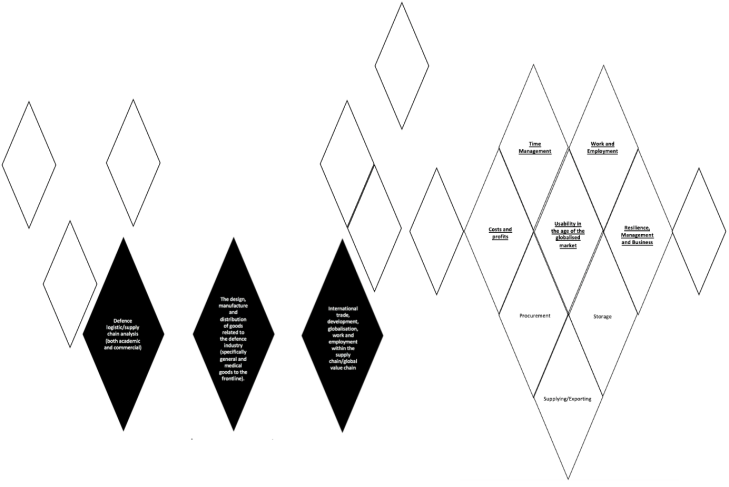
  • Defence logistic/supply chain analysis (both academic and commercial)
  • The design, manufacture and distribution of goods related to the defence industry (specifically general and medical goods to the frontline).
  • International development, globalisation, trade, work and employment within the supply chain/global value chain field.